 Field Guide
Article | Lessons from the 2025 Hong Kong High-Rise Fire by Safety Saarthi Private Limited from Pune,India.
What Indian Cities Must Learn for Safer Urban Living 🏢
India's skyline is rising—but are we building safe enough to avoid another Hong Kong tragedy? Over 146 lives lost in Hong Kong's deadliest high-rise fire is a warning no Indian city can afford to ignore.
The November 2025 Hong Kong apartment fire wasn't just a local disaster—it was a brutal reminder of how modern urban development can become a deathtrap if fire safety, façade materials, and renovation protocols are not enforced and maintained. In a nation where Mumbai, Delhi, Bengaluru, and other cities add new towers each year, this tragedy demands urgent introspection and action from everyone responsible for our built environment.
As someone who's inspected over 300 high-rise buildings across India, I can tell you: what happened in Hong Kong could happen here next week. The warning signs are everywhere—and we're running out of time.

Image Source: Hindustan Times
On a dry afternoon in Hong Kong, at 2:51 PM local time, a small flame appeared at Wang Fuk Court—a massive public housing complex in the Tai Po district comprising 8 towers, each 32 storeys tall, housing approximately 4,600 residents.
The blaze started at the corner of bamboo scaffolding wrapped around Wang Cheong House (Tower F), one of the eight residential blocks. The exact cause remains under investigation, but authorities suspect it may have ignited from construction debris, discarded cigarettes, or welding work.
The scaffolding wasn't just bamboo—it was wrapped in plastic safety netting, construction tarps, and most dangerously, expanded polystyrene foam boards covering the windows. These materials are highly flammable.
Within minutes, the fire did something that shocked fire-safety experts worldwide: it jumped from the exterior scaffolding directly into residential units through windows, doors, and ventilation openings.
The vertical chimney effect kicked in instantly. The heat and smoke created an upward draft so powerful that flames raced up the façade faster than firefighters could respond. The bamboo scaffolding, arranged like a vertical ladder, acted as a superhighway for fire—climbing seven storeys every few minutes.
The scaffolding created a connected “fire highway” between all eight towers. Embers and flame from Tower F spread along the bamboo supports, plastic netting, and exterior surfaces to adjacent towers—G, H, A, B, C, and E. Only Tower D, which had a different external layout, escaped the main blaze.
Polystyrene boards were discovered blocking windows. These foam insulation panels, meant for waterproofing and energy efficiency during renovation, became accelerants. When fire touched them, they burned intensely, producing thick, toxic black smoke that poured into apartments and stairwells.
"Smoke was so thick I couldn't see my own hands."
"The heat was unbearable—windows shattered, letting fire inside."
"We heard explosions as the foam boards caught fire."

Image Source: The New York Times
This was the most damning discovery: investigations revealed that fire alarm systems in the eight buildings were faulty or disabled. Residents reported alarms were connected but didn't sound when the fire erupted. Some were disconnected during renovation and never reconnected. Emergency lighting failed in several stairwells, leaving residents in pitch-black smoke.
One resident, a 70-year-old woman, recounted: "I heard explosions at 3 PM but no alarm sounded. I saw my neighbor's window engulfed in flames. I didn't know if I should run or wait."
1,200+ firefighters responded, but they faced a nightmare scenario:
One firefighter (age 37) died during rescue operations; 12 more were injured. Evacuation took 12+ hours for residents in upper floors. Some waited on window ledges for 4–5 hours before rescue ladders arrived.
Mr. Li’s Account (32nd Floor, Wang Tai House): At 2:51 PM, his wife called from outside the building warning him about the fire visible from a distance. Smoke began entering his apartment within minutes. He initially tried to exit but was overwhelmed by thick smoke in the hallway. Retreating to his flat, he placed wet towels under the door, called his wife to say he was trapped, heard explosions as polystyrene boards ignited below him, helped two elderly neighbors seek refuge, and was rescued around 5 PM after firefighters reached his window with ladders.
The Elderly Residents' Tragedy: Over one-third of Wang Fuk Court's 4,600 residents were elderly (65 +). Many couldn't navigate thick smoke or climb down rescue ladders. Search and rescue teams found many dead in their apartments, apparently overcome by smoke before they could reach exits.
On November 27 (just hours after the fire), Hong Kong Police arrested three senior staff members of the renovation contractor, Prestige Construction & Engineering Company, on suspicion of manslaughter. The Independent Commission Against Corruption later arrested eight more on corruption charges after discovering that fire-resistant materials had been replaced with cheaper, flammable alternatives and inspection reports were falsified to cut costs.
Experts from Hong Kong Polytechnic explained the vertical “chimney” effect created by bamboo scaffolding wrapped in tarps and foam insulation—allowing fire to race upwards seven storeys in minutes instead of one or two storeys per 10 minutes as in typical high-rise fires. Toxic black smoke with carbon monoxide and hydrogen cyanide caused rapid incapacitation and zero visibility.
Hong Kong’s Secretary for Security Chris Tang stated that the protective netting and plastic sheeting “burned far more intensely and spread much faster than compliant materials normally would.” Fire experts concluded that the root cause was not just the ignition but the failure of building systems and materials to contain or slow the fire.
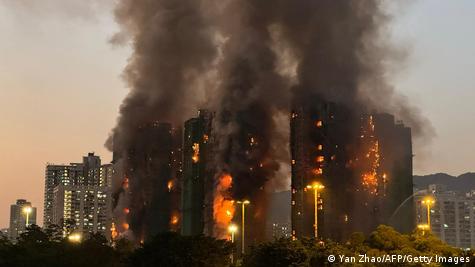
Image Source: Yan Zhao/AFP/Getty Images
Require non-combustible or flame-retardant materials for scaffolding covers/cladding above 15 m. Ban plastic tarpaulin, untreated bamboo netting, and foam insulation. Mandate fire-rated metal mesh or non-flammable fabrics and third-party fire testing before installation.
All temporary works must be vetted by local fire authorities and maintain clear escape routes. Conduct pre-renovation tests for alarms, sprinklers and emergency systems; ensure unobstructed fire-truck access; blacklist violators and impose penalties.
Shift from one-time fire NOC approvals to continuous digital maintenance. Require annual audits for occupancy renewal; publish each building’s “fire health score.” Offer insurance and tax benefits for gold-standard safety records.
Mandate pressurized stairwells, functional refuge floors and fire-safe evacuation lifts in towers above 20–30 storeys. Conduct annual evacuation drills with documented participation, especially for senior or mobility-impaired residents.
A1: Yes—non-combustible materials above 15 m per NBC Part 4 and IS 6697 / 1646.
A2: Steel scaffolding with flame-retardant mesh; avoid plastic and bamboo.
A3: Monthly alarms/sprinklers + annual pump tests under IS 2189.
A4: No. Egress paths must remain clear at all times.
A5: Yes, and they must file reports with local fire authorities.
A6: Never; they’re life-safety zones only.
A7: Pressurized stairs, aspirating detectors, IoT heat sensors.
A8: Check BIS-certified lab reports or commission sample tests.
A9: Developers liable five years; criminal charges for gross negligence.
A10: Digital fire-NOC systems and mandatory annual audits in major cities.
Your building’s fire safety is not just compliance — it’s survival. Act now.

Have a fire safety question on your own project?
Talk to our engineering team before it becomes a site-stage problem — we work across fire protection, electrical, HVAC and plumbing systems for industrial, commercial and data centre sites.