
India’s data center capacity is expected to triple by 2030, but data center fire safety risks—especially lithium-ion battery fire suppression systems and AI-powered fire detection systems—are growing faster than ever.
The September 2024 Wake-Up Call
In September 2024, two catastrophic fires rocked the data center world:
Singapore Incident: A lithium-ion battery thermal runaway at Digital Realty burned for over 36 hours, crippling Alibaba Cloud services, delaying hardware recovery for weeks, and costing an estimated $50 million in service disruption.
Jio Blackout: A blaze at a Reliance Jio data center triggered a nationwide outage, impacting 489 million subscribers and highlighting the fragility of mission-critical infrastructure.
Concerned about data center fire protection installation? Schedule a free 30-minute risk assessment call with our experts.
Three Hidden Threats Multiplying Your Fire Risk
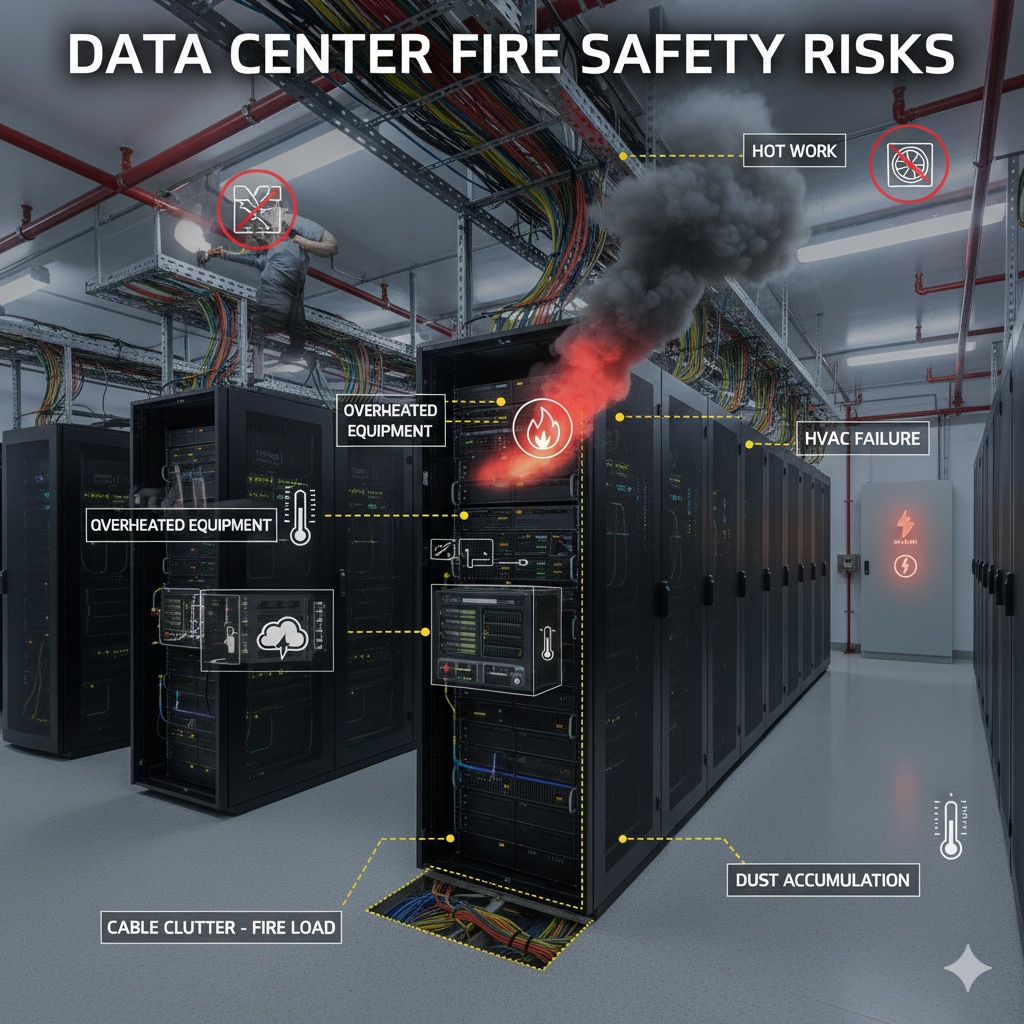
1. Lithium-Ion Thermal Runaway
23 lithium-ion battery fires have been documented in data centers since December 2023.
78 percent occur in battery rooms or UPS areas, where clean agent suppression and pre-action sprinklers often fail to stop thermal runaway.
Toxic gas release includes hydrogen fluoride, carbon monoxide, and other off-gassing chemicals that can kill in minutes.
Real-World Anecdote: One Pune operator upgraded to a FK-5-1-12 clean agent suppression system with VESDA early smoke detection. When their UPS battery began overheating, VESDA alerted them 12 minutes before visible smoke—allowing a controlled shutdown and preventing a ₹50 crore loss.
2. AI Workload Heat Bombs
AI server racks now draw 50 kW+ per rack compared to 5–10 kW for traditional servers, generating extreme heat loads that overwhelm conventional sprinkler and clean agent designs.
Thermal hotspots caused by AI workloads accelerate cable insulation degradation and electrical fires.
3. Interconnected Failure Cascades
HVAC shutdown triggers temperature spikes.
Equipment failure follows, leading to ignition.
UPS thermal runaway releases toxic gas, forcing evacuation.
Network disruption cascades into data loss and costly downtime.
The 3-Layer Defense Strategy
| Layer | Solution |
|---|---|
| Building Foundation | Fire-rated walls; traditional sprinklers; portable extinguishers |
| Room-Level Protection | Pre-action sprinklers; FK-5-1-12 clean agents; VESDA detection |
| Rack-Level Precision | Rack-level suppression units; temperature monitoring; isolation |
Download our free “Data Center Fire Risk Assessment Checklist.”
🔍 Infobox: Key Terms to Remember
data center fire safety India
Lithium-ion battery fire suppression system
AI-powered smoke detection
thermal runaway prevention
battery energy storage system fire
hyperscale data center fire safety
NBC 2025 data center standards
clean agent suppression in India
⚙️ The Science Behind Modern Fire Suppression
FK-5-1-12 vs HFC227-ea
Environmental Impact: FK-5-1-12 has a global warming potential of 1 vs HFC227-ea 3,500.
Atmospheric Lifetime: 5 days vs 33 years.
Suppression Speed: Under 10 seconds for both; zero residue.
Regulatory Future: FK-5-1-12 is EPA-approved; HFC227-ea is being phased out.
VESDA-E Aspirating Smoke Detection
15× more sensitive than conventional detectors, capturing particles at 0.002 percent obscuration per meter.
Ideal for high-airflow environments, providing very early smoke detection.
Real-World Impact: In one Bangalore hyperscale facility, VESDA detected a cable hotspot before visible smoke formed, preventing a multi-crore fire incident and 72 hours of downtime.
The Lithium-Ion Challenge: What You Need to Know
Trigger: Overcharge, physical damage, or manufacturing defect.
Thermal Runaway: Cell temperature exceeds 150 °C, releasing oxygen and fuel.
Chain Reaction: Heat spreads to adjacent cells, self-sustaining.
Explosion & Off-Gassing: Hydrogen fluoride, carbon monoxide, and other toxic gases.
Re-Ignition Risk: Even after apparent extinguishment, cells can reignite.
Protection Strategies
Enhanced temperature monitoring and predictive fire safety analytics.
Specialized ventilation for toxic gas management.
Hybrid suppression: clean agent for initial knockdown plus water mist for cooling.
Emergency battery isolation protocols.
Get our “Lithium-Ion Battery Fire Risk Assessment Checklist” now.
FAQ
Q1: What are the best predictive fire safety analytics tools for data centers?
A1: AI-powered platforms integrate sensor data, machine learning algorithms, and real-time risk scoring to provide actionable alerts.
Q2: How do machine learning fire prevention systems improve response times?
A2: ML models learn normal patterns and detect anomalies faster, reducing false alarms and accelerating suppression activation.
Q3: What does NBC 2025 require for data center fire safety in India?
A3: Performance-based design, mandatory cybersecurity protocols for IoT fire monitoring systems, and specialized provisions for data centers.
Q4: Should I replace HFC227-ea with FK-5-1-12?
A4: For new installations, FK-5-1-12 offers superior environmental impact and future-proof compliance. Existing HFC227-ea systems should be evaluated during major upgrades.
Q5: Is VESDA worth the extra cost?
A5: Yes. Early detection prevents multi-crore losses and extended downtime, delivering clear ROI.
🔗 Strategic Call to Action
Concerned about data center fire suppression cost, or need an expert fire safety consultant? Click here to request a free battery room audit today.
🚀 What’s Coming in Part 2:
“How NBC 2025 & Modern Technology Are Redefining Data Center Protection”
Deep dive into NBC 2025 data center standards in India
Maharashtra’s pioneering fire safety regulations
ROI comparison of clean agents vs water mist vs hybrid systems
Future-proof design recommendations for sustainable, AI-driven fire protection
Explore our comprehensive fire suppression solutions:
Fire Suppression Systems
References & Standards Consulted
National Building Code of India (NBC) 2016 and Draft NBC 2025 (Part 4: Fire and Life Safety) – Bureau of Indian Standards
NFPA 75: Standard for the Fire Protection of Information Technology Equipment – National Fire Protection Association
NFPA 76: Standard for the Fire Protection of Telecommunications Facilities – National Fire Protection Association
IS 2189: Indian Standard for Fire Hose and Fire Protection Equipment
IS 6382: Indian Standard for Carbon Dioxide Fire Extinguishing Systems
UDCPR Guidelines for Maharashtra State Fire Safety – Maharashtra Fire Safety Bill, 2023
Technical Reports on Lithium-Ion Battery Fire Suppression – International Fire Safety Organizations such as the Fire Protection Research Foundation (FPRF)
Case studies and incident reports on the Digital Realty Singapore data center fire (September 2024)
Report on the Reliance Jio data center fire and corresponding nationwide outage (September 2024)
Publications on Very Early Smoke Detection Apparatus (VESDA) and aspirating smoke detection technologies – Xtralis and Jem Systems
Environmental Protection Agency (EPA) regulations on clean agent fire suppression systems, including FM-200 phase-down and Novec 1230 approvals
About Safety Saarthi Pvt. Ltd.
📧 Email: connect@safetysaarthi.com
📞 Phone: 7066729911 / 9673407788
💬 WhatsApp: 8484060560
🌐 Website: www.safetysaarthi.com
Follow us:
